
Orthopedics offers many ways to impact patients’ lives…you can reach across the OR table and you can reach across the world. Dr. Richard Coughlin, an orthopedic surgeon with the University of California, San Francisco (UCSF), has found that the most impact lies in the latter.
The co-founder and director of IGOT, the Institute for Global Orthopaedics and Traumatology, Dr. Coughlin states,
If a child has an open fracture in sub-Saharan Africa, there is a good chance that he will develop chronic osteomyelitis and will require an amputation. This eventually impairs his ability to make a living, and he becomes a burden on his family. There are more instances like this than you can imagine…there are more of these cases than there are of HIV.
Indeed, says Dr. Coughlin…according to studies, musculoskeletal problems are more of a global health burden than HIV, malaria, and tuberculosis combined. To address this, in 2006, Dr. Coughlin, along with Drs. Richard Gosselin and Harry Jergesen set out to give a man a fishing pole. “We could see that the most powerful and lasting way to impact global musculoskeletal health was through empowering orthopedists in less resourced areas. To that end, IGOT focuses on building research capacity and infrastructure via academic to academic partnering. That way, countries can foster their own clinical and research capabilities, and find answers to their own questions.”
“Housed at the Orthopaedic Trauma Institute at the San Francisco General Hospital (SFGH), IGOT resides in the Department of Orthopaedic Surgery at UCSF.” Dr. Coughlin: “SFGH has a strong tradition of caring for the vulnerable, so it was only natural that we selected that facility as a ‘home’ for IGOT. And because of our academic affiliation with UCSF, we can readily partner with academic institutions around the world. For example, IGOT has provided financial and leadership support for orthopedic residents in Uganda who are conducting research projects. We have also funded visiting professorships for African academic leaders to UCSF and the AAOS Educators Course.”
You might think of Richard Coughlin as Mother Teresa with a database. An enthused Dr. Coughlin notes, “No one is doing this! IGOT is a far-reaching, sustainable enterprise which involves collaborating with smart, compassionate academic orthopedic surgeons from resource poor countries. We are helping empower these surgeons so that they can train their own people and start answering their own research questions. These are typically clinical questions such as, ‘Is it more cost-effective to use a flexible nail for a pediatric fracture in a sub Saharan country?’ or ‘How long should someone stay in traction?’ We are definitely not going there to figure out their questions and answers…that would be disempowering.”
As someone who has experienced a range of ways to help others, Dr. Coughlin says that he could not stand by and do nothing about the larger problem (translation: he couldn’t stay in the OR). Dr. Coughlin, who studied at the London School of Hygiene and Tropical Medicine and received his Masters in Public Health for Developing Countries, states, “I have been working abroad for 20 something years. When I see the well-heeled set complaining of tennis elbow or I have to deal with lawyers and excess paperwork, I am frustrated because then there is less time for impactful work. There are tremendous pathologies and disparities in the world, something that really ‘came home’ to me when I spent three months in South Africa and saw an extraordinary amount of trauma and a need that could never be filled by surgeons flying in and performing surgeries. While there is no question that this improves lives, it is just not the most impactful way of helping others.”
Opening up about his philosophy, Dr. Coughlin states,
A bit under duress, last year I went to the Dominican Republic with a well established volunteer charity. By the end of the week we had seen a lot of trauma, but there was no education or training. I was almost embarrassed. As those from Médecins Sans Frontières (MSF) say, we physicians are the witnesses to trauma, atrocities, disparity, and injustice—and we must stand up and make changes.
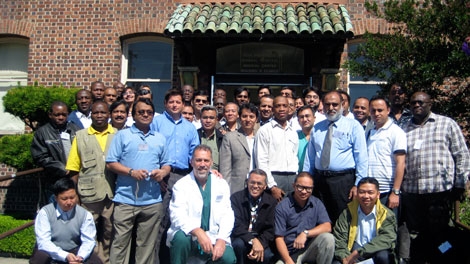
A man of his word, Dr. Coughlin and the other exceptional IGOT staff have made concrete things happen for their less resourced colleagues. “Last year we were the host for a regional, soft tissue flap course along with SIGN, the Surgical Implant Generation Network. In all, 50 orthopedic surgeons from Pakistan, Nepal, and Africa came to UCSF for two days to work with plastic surgeons and learn how to do rotational flaps. The immediate feedback was stunning: we received emails from these surgeons within days saying that patients who had been stuck in the hospital for months had undergone the flap surgery and could go home! That is a pretty strong multiplier effect.”
And the beat of Dr. Coughlin’s “self sufficiency first” drum gets louder. “This year we are expanding the course, and adding a day long workshop on how to do clinical research. Twenty-five participants will learn the ins and outs of formulating a research question, etc., and will go forward to create a consortium that will address substantial clinical questions.”
Like any decent researchers, the IGOT team wants to know the details. And those, says Dr. Coughlin, are “on the ground.” “Our major goal this year is to determine the status of clinical research in sub-Saharan Africa, and then find out how we can help our colleagues there move forward. The work of these surgeons is hardly represented in the literature…looking at four major orthopedic journals over three years, we found that only .4% of the articles were from sub-Saharan Africa. It’s a long-term project, but to start, we are sending a medical student to do qualitative interviews at three sites. We want to find out about attitudes toward clinical research, and see what the surgeons say are the barriers to clinical research. We also want to know what they consider to be the most important journals for them, i.e., is it better to publish in the East African Medical Journal, the British Journal of Bone and Joint Surgery, etc. Following this initial work, we can strategize and undertake a larger study that will involve as many sub-Saharan sites as we can enroll.”
IGOT’s specific GPS coordinates point toward the UCSF/SFGH Orthopaedic Trauma Institute (OTI). “Dr. Ted Miclau and I created the OTI ten years ago; now we are in a three floor building with ten full-time orthopedic surgeon faculty members and a host of physical medicine and podiatric professionals. When you look at the global inequities of musculoskeletal health, you see that the vast majority involve some sort of trauma. Having IGOT here means that we can more easily keep the focus on solving the capacity building issues that are related to trauma.”
Because of its cadre of experienced academicians, IGOT can reach far and wide. Dr. Coughlin notes, “Dr. Ted Miclau, Professor and Vice Chair of Orthopaedics at UCSF, is on the IGOT board. He has led several large projects, such as a clinical research course in Havana that drew 135 Cuban surgeons last year. He also organized a course in Mexico where over 1, 000 medical professionals had access to learning about clinical research.”
Other examples of IGOT power? “We provided the financing for the first research in Uganda on the surgical impact of chronic osteomyelitis. Also, my wonderful co-director, Dr. Richard Gosselin—who is always ‘on the road, ’—is lead Orthopedic Consultant for MSF and is on the faculty at the University of California, Berkeley School of Public Health. Then there is Dr. Harry Jergesen, who has provided consultation to Nicaraguan educators about their orthopedic resident training. And we have Dr. Amir Matityahu, who has recently spent ten months traveling to all of the major trauma centers around the globe so that he can write a paper on the worldwide trauma system.”

Harry Jergesen with collaborator Dr. David Oloruntoba
at Bedford Orthopaedic Center, Mthatha, South AfricaWith so much need, how does the IGOT team know where to invest its time and energy? “We have found that we get the biggest impact from working in locations where there is some history of orthopedic training or research. Partnering with Orthopaedics Overseas offers great synergy of mission. This enables us to spend more time helping to strengthen the orthopedic leadership capacity as opposed to just getting things off the ground. Uganda was a great ‘bet’ as it does have such a history; Orthopaedics Overseas started a residency program there and we have been able to send their Chairman to the AAOS Educators’ Course and provide a Visiting Professor opportunity at UCSF.”
So they must have an NIH (National Institutes of Health) grant for all of this work, right? No…they have a big-hearted bartender. “We raise money where we can. There is even a local bar owner who gives us $5, 000 a year and likes to say, ‘Drink Locally…Act Globally.’”
“My goal is to be able to grow IGOT to the point where we have an improved infrastructure and even more sustainability. Having a dedicated development person and/or several full time researchers would allow us to pursue the larger NIH grants or substantial private grants.”
A man on a very doable mission, Dr. Coughlin says, “Through academic partnering we are able to advance the training, clinical research capacity, and leadership development of those in the poorer areas of the world. Increasingly, our world is more connected…and medical students are having more and more global experiences. Instead of just having a ‘buzz’ about the latest unproven gizmo, why can’t we create a ‘buzz’ about a new research facility in Tanzania that will change countless lives for generations?”
And there is the issue of sending signals…indeed, of being patronizing. “If we remain mired in the old model of helping, i.e., flying to XYZ country to do surgeries and leaving without having trained anyone, then we are sending the wrong message. We are saying, in effect, ‘We have to do it for you.’ Giving our orthopedic colleagues the tools to create the change their countries need means many things…one of which is that they will be more respected locally and then they can vie for resources themselves.”
Dr. Coughlin: “We are a global family of orthopedic surgeons. Let’s treat one another with the utmost respect and care.”
