
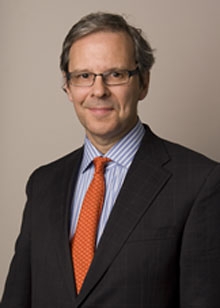
When Vincent Arlet did his training, the words he heard in class were “une ostéotomie” and “l’osteonécrose.” Born in Paris in the late fifties, Dr. Vincent Arlet, the Warren G. Stamp Professor of Orthopedic Surgery and Professor of Neurosurgery at the University of Virginia (UVA), has come to see his dual worldview as particularly helpful when it related to orthopedics.
Importantly, Dr. Arlet is also the inventor of Scolisoft, an essential software database tool that has changed the way surgeons treat patients with scoliosis. What motivated such an esteemed professor of orthopedics to become a database developer? “My mom was a homemaker and my dad was an engineer. I found his work stimulating, and had my sets set on following in his footsteps.”
But he temporarily lost sight of that engineering goal when he lost sight of his skis. “I had a ski accident in high school that almost killed me. I had severe intra-abdominal bleeding and the only surgeon in the local hospital was an orthopedist…he saved my life. Because I missed three months of classes, I couldn’t get into any engineering schools. As I interacted with my doctors, I thought, ‘Medicine looks interesting. These people are intense and get to make truly important decisions.’”
Now a seasoned surgeon, researcher and accomplished database innovator, Dr. Arlet helps others get started. As Chair of Spinal Deformity Research at King Saud University in Riyadh, he is laying the groundwork for Saudi surgeons who want to pursue a career in research. “Saudi Arabia has a population of 25 million, but only a handful of spine surgeons. Two years ago the Chief of Spine, Dr. Abdulmonem Alsiddiky, asked me to help establish their research program and assist with complex spine surgeries. Twice a year I travel to Riyadh both to operate and to help clinician researchers establish the framework for their research and spinal deformity program. The extremely challenging pathology I see there is usually only something found in textbooks.”
Deputy editor of the European Spine Journal, Dr. Arlet has a deep appreciation for the value of learning from others. “I was fortunate to have superb mentors, including Dr. Jean Paul Padovani, who had such an extensive knowledge of pediatric orthopedic pathology that even specialists—such as geneticists—would consult with him. I must also credit Dr. Max Aebi, Chairman of Orthopaedics at McGill University. His ability to conceptualize the entirety of a surgery taught me how to understand the surgical problem and how best to ‘attack’ it. Without him I would never be where I am today.”
In perhaps the first case of “orthopedic stalking, ” the determined Dr. Arlet often sought the advice of Dr. Jean Dubousset. “I never trained with Dr. Dubousset, who developed the most famous method of spinal instrumentation ever invented. But I would seek out meetings where I knew he would be in attendance…and I would bring my X-rays of particularly difficult cases. Once I found him, I would scribble his recommendations on the folders.”
As an established surgeon, Dr. Arlet would use his skills in diplomacy to lead orthopedic departments. The insight needed to manage this task began in his early years, with the dawning realization that politics is everywhere. “European career pathways are very hierarchical. This means that to attain academic milestones you have to contend with an extraordinary amount of politics. In American medicine, for example, when there is a position available, there is usually a nationwide search; in Europe they usually don’t look beyond the hospital grounds. I saw many instances of those who were better qualified not even being considered for jobs. I was frustrated with the system, and was planning on entering private practice in France. That is when I was offered a position at McGill University in Canada.”
Dr. Arlet remained a member of the McGill community for 13 years, during which time he became director of the spine division, as well as head of the spine fellowship. “I started out doing 50/50—half of my surgeries involved children and the other half involved adults. The Chair, Dr. Aebi saw an evolving need for a vertical concept of spine treatment from birth to the elderly, so I altered my practice and began to work more with adults. Once I moved to UVA my practice began to consist of about 90% adults.”
And the young residents and fellows who trail behind him on rounds are often surprised by what seem like radical words. “When I tell trainees to ‘Forget the X-rays and listen to the patient’ they are rather shocked. I explain, ‘If you have someone with complex adult scoliosis—with an obvious curve—but the only thing he complains of is leg pain, then you probably shouldn’t do a big surgery. The rest of the disease is not important enough for him to want to undergo such an extensive procedure. So you can do a big operation, get the spine perfectly straight and feel proud of yourself, but the patient isn’t happy because he has had a major surgery and he now has post operative complications.”
Orthopedic trainees who want to learn more about the nervous system come to see Dr. Arlet at UVA. “There are only several places in the U.S. that have a combined orthopedics/neurosurgery fellowship…we are one of them. We learn from neurosurgeons how to handle nerve tissues and they learn certain aspects of biomechanics from us. It’s interesting to see a young surgeons’ thinking evolve. Right after they have completed their training, they think that they are the only ones who know the truth. Then they see others doing something different and getting good outcomes and think, ‘Well, they are not wrong.’”
So what is Dr. Arlet especially proud of? Scolisoft. “I have established an online database of scoliosis cases that can be used by any surgeon worldwide. The impetus for this goes back to my mentor, Dr. Padovani, who had several cupboards filled with slides. When a challenging case came in we would go to his cupboard and find an identical case. Years later at McGill I commented to a resident how nice it would be to have a clinical answer on the other end of a mouse click. He got to work and we soon had an embryonic software…now there are 300 cases. We only include those cases that have been documented extensively. The biggest challenge is to get surgeons to submit cases. But those who get involved really benefit…they can find cases that are identical to the one they are dealing with.”
When asked about his favorite research, Dr. Arlet discusses a study that shows “more is not always better.” “We had cases from Scolisoft reviewed by scoliosis surgeons and then laypeople, all of whom were blinded to some part of the procedure. The tendency is for people to think that more screws, etc. results in better outcomes; our study showed that when blinded, surgeons do not think this is true. For example, if I have a patient with a 55° right thoracic curve, 30 years ago we would have used a Harrington rod and two hooks. Fifteen years ago we would have used two rods and eight implants; now, some surgeons would put in two rods and 24 screws!! Our study showed that with a middle grade curvature, it is unlikely that you need such an extensive number of screws.”
As for how his European background and North American experiences contribute to his success, Dr. Arlet says, “When there is a new trend in spine I try to have a critical appreciation of it. The first reaction of North Americans is to be open to new things, whereas Europeans tend to criticize first. Then if something doesn’t work North Americans are the first ones to drop it (Europeans may keep it for a longer time, especially if this has become a tradition!) We all need to be wary of things that are unproven. On the other hand we must be ready to abandon techniques that do not work.”
Dr. Arlet is unusually honest about the experience in his career that most changed him. No, it wasn’t any sort of accolade. It was failure. “Like everyone, I have had surgical failures. Having a complication in spine surgery is devastating…it was your own hands that didn’t do the job right. This is when you really learn how to talk to patients—you must look them in the eyes and tell them the whole truth. Then you do everything in your power to ensure that it doesn’t happen again.”
Several times a year, Dr. Arlet takes his experience and skills to Trinidad. “There is one pediatric orthopedist—Dr. David Toby—for this island of 1.2 million people. I started helping him with the big cases—those with over 100° curvature—in 2006. While Trinidad has a fairly high GDP, the resources for specialized surgery aren’t available. I’m proud to be part of this effort, which is affiliated with FOCOS, the Foundation of Orthopedics and Complex Spine.”
As an academic surgeon, there is little room for downtime. Especially when you have four children. “My wife Anne and I have a 26-year-old daughter who is a family medicine resident at McGill, a 24-year-old son who just graduated from Columbia, a 20-year-old at Virginia Commonwealth University, and our ‘baby, ’ who is in high school. We find as much time as we can to get out on the water and do some sailing. My wife has been invaluable in helping me find balance; as academic surgeons we have the tendency to throw ourselves too heavily on the side of work.”
Dr. Vincent Arlet…a critical eye plus an honest heart equals success.
