
It’s 2 am and a patient rolls into the ER with several fractures. What should be addressed acutely? What if you suspect a bleeding problem? What are the issues associated with waiting? Along with Drs. Mark Lee, Yvonne Murtha, and Philip Wolinsky, Dr. Brett Crist, Co-Chief of Orthopaedic Trauma at the University of Missouri, reviewed the latest evidence-based literature regarding the surgical timing of injured extremities. The researchers then presented their findings at the 2011 meeting of the American Academy of Orthopaedic Surgeons.
Dr. Crist states, “For several years there has been a debate over the merits of early total care versus staged injury management. Fortunately, there is a lot of good work in the literature to help us identify patients who would benefit from what we call damage control orthopedics, i.e., the staged approach.”

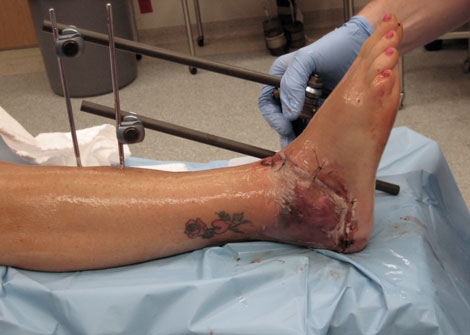
Photo courtesy Dr. CristGoing in and fixing everything during one, long surgery, says Dr. Crist, is just not appropriate for every patient. But there are few hard and fast rules for surgeons to follow. Dr. Crist: “The key is to try to identify the patients who would be harmed by early total care. Several years ago Dr. Hans-Christoph Pape worked with colleagues in Germany to establish guidelines for acute versus staged care. Their research determined several situations in which a patient should receive staged treatment: if there are bleeding problems, if someone is under-resuscitated, if they are hypothermic, have a significant chest injury, or if they have multisystem injuries. Of their study subjects, those who had all these or two out of three of these were at high risk for the ‘second hit phenomena’ where the inflammatory response causes significant problems potentially leading to multisystem organ failure. ”
Black and white…easy to identify. Other colors…not so much. “There are extremes at each end of the spectrum, with, for example, an isolated femur fracture identifiable as something that can be fixed acutely. Then there are patients with head, chest, extremity, and abdominal injuries who clearly cannot and should not receive total acute care. It’s the ones in the gray zone that can be challenging to identify. We can fall back on the literature, however, for guidance. For example, most studies have shown that fixing high energy pilon fractures acutely leads to an increased risk of infection and wound problems. Due to literature in the late 1990s showing decreased risk of infection and wound problems with the staged approach, today these injuries undergo staged management at most centers.”
A large swath of the gray zone, states Dr. Crist, involves those patients with multiple orthopedic injuries.
Let’s say that someone comes in with a fractured femur and tibia, and is awake and alert, but has a pulmonary injury that is evolving. The decision making process would be to determine if this patient is adequately resuscitated and how extensive his pulmonary injury is. Using the Hanover Criteria—the aforementioned work from Dr. Pape and his colleagues—is helpful. In addition, one should also look at lactate levels, urine output, fluid and blood requirements.
“This is mainly determined by allowing a complete evaluation by the general surgeons and orthopedists before rushing to the OR from the ER to nail the long bone fractures. Problems can be avoided by making sure that the patient is not trending toward having pulmonary problems that might be worsened by a prolonged orthopedic surgery. So to avoid problems, adequate evaluation with published guidelines should be used and insure adequate fluid resuscitation.”
So when do you stand up and pay very close attention? Dr. Crist states, “The literature shows us that the treatment of joint dislocations should not be delayed because this may result in avascular necrosis or neurovascular compromise. Studies show that hip dislocations should be treated in less than 12 hours and others indicate that less than 24 hours can help avoid an increased risk of avascular necrosis. The barrier to such acute treatment is typically being able to reach a facility that has the appropriate abilities to manage these injuries (most likely an issue in a rural area).”
But, says Dr. Crist, the literature needs more work. “Dislocations are either urgent or emergent, depending on the joint. While we have good data for the hip, unfortunately, the literature is not as good when it comes to other joints.”
And if you see blood vessels in distress, advises Dr. Crist, get moving. “The literature has concluded that a patient with vascular issues is indeed emergent given the risk of significant blood loss, as well as limb loss. In this case, the liberal use of a tourniquet is appropriate, while clamping off the blood vessels would be done as a last resort. A tourniquet should only be on a couple of hours…otherwise ischemia will kick in. The literature says that these situations need to be addressed within six hours; the problem is that if you’re dealing with a large main artery there is no way that someone is going to last six hours.”

Photo courtesy Dr. CristThings are also unequivocal when the nerves, blood vessels, and muscles are being compressed and starved of oxygen. “Compartment syndrome is a true emergency, and needs to be fully addressed in an acute fashion. Researchers reviewed insurance claims and litigation for compartment syndrome at Massachusetts General Hospital claims over a period of 20 years. The situations that resulted in the highest payouts/awards against the physicians were those where there was a delay in treatment (a delay in seeing the patient or a delay getting to the OR).”
Dr. Crist says that the review process helped them challenge what is considered to be dogma. “For example, take the urgency of fixing femoral neck fractures in young people. The general thinking has been that they should be done in the middle of the night if that is when the patient arrives. But with an increasing number of trauma rooms available, a recent survey of OTA [Orthopaedic Trauma Association] members revealed that if someone comes in at midnight or later then a significant number of traumatologists are starting to put them on as a first case the next morning due to resource availability.”
“When we examined literature from other countries we found that there are instances of people showing up a couple of months after their injuries and they still didn’t have avascular necrosis. It appears to boil down to fracture patterns and surgical technique—if you get an anatomical reduction and use internal fixation then chances are that the patient will fare better (risk of avascular necrosis and nonunion) than those who had malreductions. Patients with significant displacement and comminution tend to do worse. In summary, the literature indicates that you should treat femoral neck fractures as soon as you feel you can do them well. If that is 3am and you have the team and the resources, then do it.”
“With regard to talus fractures, ” says Dr. Crist, “they have traditionally been thought of as an emergency where you need to immediately reduce the joint and fix it anatomically. The problem, however, is that the soft tissues will often swell and you could have potential difficulties with wound closure or later wound breakdown. We found two studies that looked at risk of avascular necrosis; they concluded that the timing of the repair wasn’t the main factor…it was fracture type. Open fractures had a higher rate of avascular necrosis and nonunion. In these cases, one should debride the open fracture and stabilize it with external fixation or a splint—and only address it definitively when the soft tissues allow. Closed fractures should be immediately reduced and undergo definitive fixation when the soft tissues allow as well.”
As for what might prevent an orthopedist from making the best decision as far as what is an emergency and what can wait, Dr. Crist says, “Orthopedic surgeons who find themselves struggling with these situations often have resource issues such as OR access or adequate ancillary support. Something else that can be an problem is the surgeon’s expertise or comfort level with treating things such as a complex talus or femoral neck fracture.”
Ethics…can’t live without ‘em…but it’s hard to get the full picture because we must abide by them. “We would ideally have better literature going forward. But you cannot do a prospective double blind trial on an injury that is rare, and then intentionally delay care to see if it makes a difference when the dogma states you should address it as soon as possible.”
So perhaps this is why orthopedic surgeons are holding back a bit on the scalpel. Dr. Crist:
As a subspecialty we are leaning more towards staging things. The downside of a staged approach is that there is a longer hospital stay and more exposure to anesthesia. The downside of treating too acutely is that the patient may need additional surgery later, may be on a ventilator too long, or may develop a bodywide infection.
When in doubt, advises Dr. Crist…stage those injuries that can be staged.
