
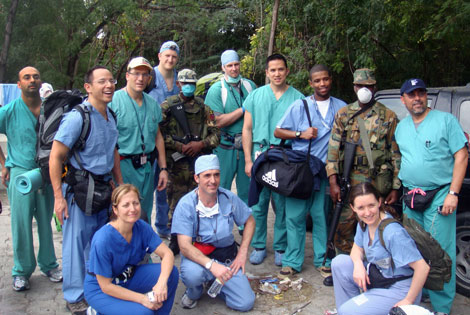
When Drs. Dean Lorich, Soumitra Eachempati and David Helfet and their team rushed to Haiti immediately after the earthquake, they did so with all the hope and altruism that made them want to be surgeons in the first place.
Dr. Lorich told OTW the team flew to Haiti on January 15 because they saw a chance to offer their skills where they were needed most and on a scale where they could help the most people.
By the time the team practically fled on the 19th in the back of a pick-up truck with armed Jamaican guards, they left disillusioned, angry, and worst of all, with a feeling in their gut that they had abandoned their patients. In fact, they were lucky to get out alive and unharmed.
As the crowd saw the team packing up to leave, things became very tense, said Lorich, and the Jamaican guards with M-16s escorted the team to safety.
Naïve Expectations
When the team got back to New York, Lorich and his colleagues decided they needed to warn fellow surgeons who wanted to go to Haiti, that if they thought they were going to come in as white knights in shining armor, they were naïve and would be sadly disappointed.
Lorich, Eachempati and Helfet wrote a letter distributed to the media offering a biting critique of the U.S. rescue effort, comparing it to the inadequate response to Hurricane Katrina in New Orleans. (Click here to read the entire letter.)
Challenges and Risks
Their criticism stung some military surgeons who took umbrage with their civilian counterparts and contacted OTW after the criticism became public.
One military surgeon wrote to OTW, “Civilian physicians have little training or experience in disaster medicine. As outlined by Dr. Lorich, it is a naïve attempt to help. Best left to our military and experienced agencies.”
In fact, one military surgeon told us that civilian surgeons dropping into a mass casualty situation in a third world country where the infrastructure has been destroyed could actually end up hurting patients. Without proper planning, security and extraction procedures, civilian surgeons could become part of the disaster and end up leaving patients dying for lack of proper follow up care.
Emotions are running high as both civilian and military medical professionals do their best to treat patients in an untreatable environment.
Lack of Coordination During Chaos
In interviews with both sides it quickly became apparent that official government/military and civilian efforts to save patients in this mass casualty situation, lacked coordination. Civilian doctors jump into an unsecured, primitive and non-existent medical infrastructure, while military doctors work through a deliberate, highly planned and secured process. But neither side talks to the other until the military has to tell someone their plane can’t land at an overtaxed airport because of higher priorities.
AAOS Offers “Good Offices”
We figured it would take a presidential effort to get civilian and military medical relief efforts to coordinate with each other. So we called Joseph Zuckerman, M.D., president of the American Academy of Orthopaedic Surgeons (AAOS).
“AAOS will absolutely do whatever it can and offer all our resources and assets to help our members coordinate with official military efforts, ” said Zuckerman. “In fact, coordinating our members’ efforts with existing relief efforts is what we have been trying to do all along.”
OTW has learned that some efforts have already begun to coordinate efforts to integrate qualified civilian physicians into the mass casualty response structure.
Lorich’s Warning
The experience of the HSS team is informative as other civilian physicians think about the ways they want to assist the medical relief efforts. The quotations below are all from the team’s letter.
“We wanted to provide acute trauma care in the midst of an orthopaedic disaster. Our plan was to be at a hospital where we could utilize our capabilities as trauma surgeons and treat the acute injuries involved in an orthopaedic disaster…”
We thought our plan was a good one and we soon learned that we were incredibly naïve. Disaster management on the ground was nonexistent. The difficulties in getting in despite the intelligence we had from people on the ground and Dr. David Helfet’s high political connections with Partners in Health, as well as the Clintons, only portended the difficulties we would have once we arrived.
The team left New York on a Friday, but didn’t get into Haiti until Sunday afternoon because the landing slot was cancelled by the military.
Once on the ground, Lorich said the team and their supplies were taken to the General Hospital. They believed this hospital was up and running with two functioning operating rooms. They found out otherwise. The hospital had been severely damaged and had no running water and limited electrical power supplied by a generator.
“Surgeries were being performed in the equivalent of a large storage closet, consisting only of amputations with hack saws.” They realized that the facility would not accommodate their expertise and equipment.

Survivors waiting for care/photo courtesy: Dean Lorich, M.D.They quickly went to another hospital a couple of miles away with running water, electricity and two functional operating rooms. There they found approximately 750 patients lying on the floor, “with pus dripping out of open extremity fractures and crush injuries. Some wounds were already ridden with maggots.”
The only local staff was a ragtag group of voluntary health providers who, like the HSS team, had made it there on their own.
We had no idea that the pre-existing medical infrastructure of the country was virtually non-existent.
The group called back to New York for more supplies and a plane landed on Sunday night at the airport with the supplies. On the way to the hospital, the supplies were hijacked.
Round-the-Clock Surgery
Their plan was for a round-the-clock surgery marathon session with the idea of being extracted Tuesday morning. They operated for 60-plus hours with almost no breaks, exhausting themselves, their supplies and their equipment. They completed around 100 surgeries, consisting mainly of amputations, external fixations of broken limbs and soft tissue debridements, many of which were done on children and babies.
The plane that was bringing a new team and supplies and that was to extract them had its slot cancelled at 6 am Tuesday morning.
“On Tuesday morning we found a huge number of new patients as the Haitian community had heard that we were trying to save limbs and not just amputate them. Families were bringing their injured from other hospitals. The hospital was forced to undergo a lockdown, closing its gates to the outside angry and frustrated crowd. We also noted that many of the patients we had operated on were becoming septic and would require additional surgeries.”

Last operation/photo courtesy Dean Lorich, M.D.They finished operating at noon on Tuesday and for their last surgery, assisted an obstetrician on a Caesarian section and subsequent resuscitation of a newborn who was not breathing.
“Untenable”
The group decided that the situation at the hospital was untenable as their supplies were running out, they were beyond exhaustion and safety was rapidly becoming a concern. On top of that, they had no firm extraction/resupply plan.
They needed the Jamaican soldiers to escort them out of the hospital as the crowd saw the team abandoning the hospital. The group made it to the airport on the back of a pick-up truck.

Team packs up and leaves/photo courtesy: Dean Lorich, M.D.At the airport, they got onto the tarmac, hailed a commercial plane that was returning to Montreal and had a private jet pick them up from there.
“Intense Questioning Merited”
Upon their return to New York the team decided to speak out about “the complete lack of organization on the ground…The fact that the military could not nor would not protect the critical resupply medical equipment on Sunday or let the Tuesday flight come in is devastating and merits intense questioning.”
“The lack of support for our operation by the United States is shocking and embarrassing and shows how woefully unprepared we are for the realities of disasters such as these. We came to understand that ours was an isolated operation which is a feature that may work in a mission but not in a disaster situation. We first thought we were support for those at the helm and soon realized we were not only the first responders, we were almost the only early responders with the critical expertise and equipment to treat an orthopedic disaster such as this.”
“Medical doctors are coming into the country with no plan of what they are going to do, and nobody directing them how to do it. Surgeons that expect to just show up and operate are mistaken as to what their role would be and without a complement of support staff and supplies they would be of limited to no value.”
We left feeling as if we abandoned these patients, the country and its people and we feel terrible. Our role now being back in New York is to expose the inadequacies of the system to the media in the hopes of effecting a change in the system immediately.
As the civilian and military medical communities begin the efforts to work together in a more coordinated fashion, some good may come from this experience. We’ll keep you posted.

I was one of the members of that surgical relief team. I was Dr Dean Lorich Surgical Technologist. And if you can see this Dr.” I Miss You”
P.S. Omee.